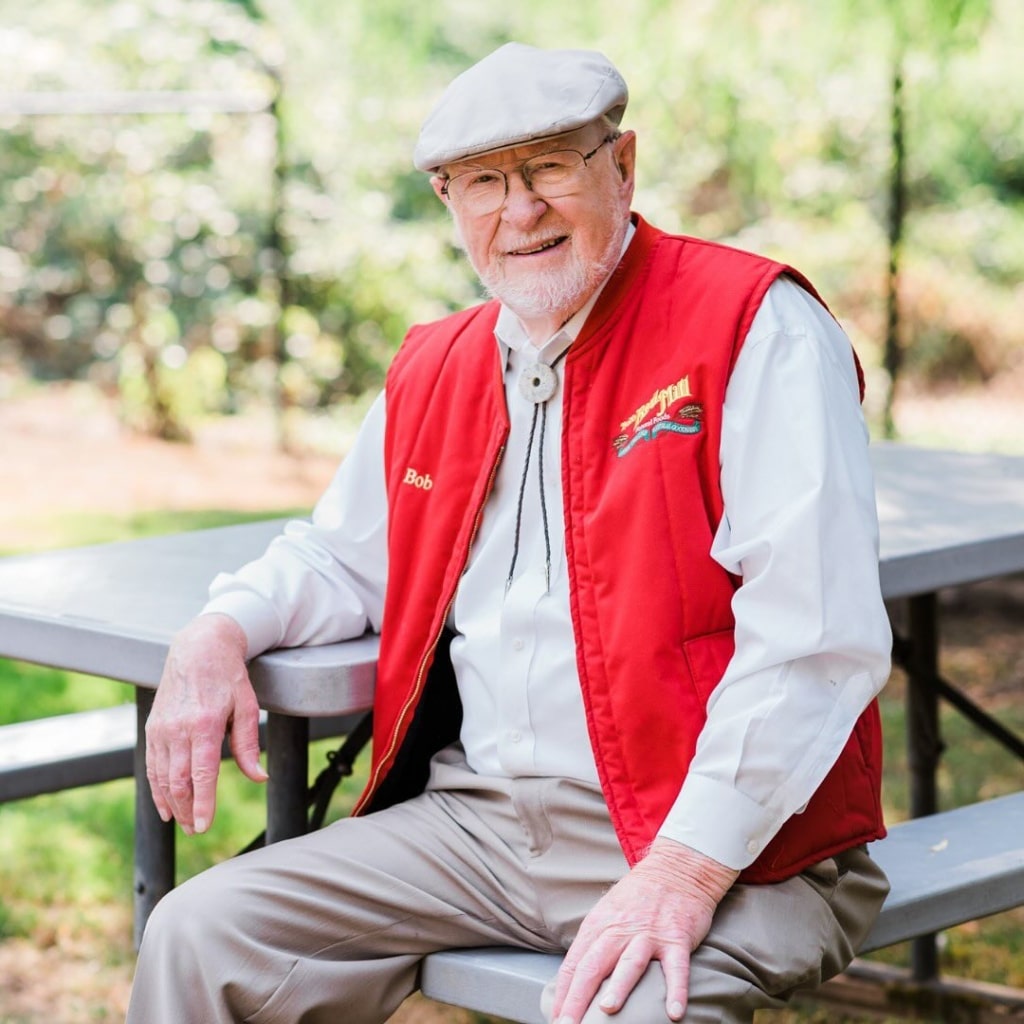
Bob Moore, the founder of Bob’s Red Mill, refused to play by the corporate rules. Instead of most capitalists’ fantasy of a multimillion-dollar takeover, Moore did just the opposite. He didn’t sell his natural foods firm to a giant food giant; he transferred the leadership into the hands of the very individuals who helped him build it, his workers.
Moore, who passed away on February 10, 2024, at the age of 94, left behind more than a company. He left an ideology: a company can be created through generosity, integrity, and purpose.
Launching Business Later in Life
Moore didn’t start his empire until he was 49. Up until that point, he had been his own gas station owner and a J.C. Penney store supervisor. He spent his period of early retirement studying the Bible and practicing his interest in whole grains.
That early retirement didn’t last for very long. In the late 1970s, Moore launched Bob’s Red Mill, and it truly became an international name, selling more than 200 items worldwide in more than 70 countries.
Forbes estimated the company’s annual revenue at more than $100 million by the year 2018.
Moore’s ambitions, though, were greater than dollar figures. He wanted his company to mirror his own morality, and his favorite scripture of all time, Matthew 7:12: “Do unto others as you would have them do unto you.”
A Radical Ownership Proposal
At the age of 81 in the year 2010, Moore shocked the world. He could’ve sold Bob’s Red Mill to any corporation knocking at his door, but he created an Employee Stock Ownership Plan (ESOP). They only had up to 200 employees at the time.
Up to the year 2020, the company grew to 700, and all were automatic stockholders. It was a brave decision for an industry whose rule of thumb is mergers and acquisitions. Moore contended that the traditional models of businesses often put owners’ interests ahead of the workers’ welfare.
“I learned almost 70 years ago how integral hard work and kindness is to success,” he exclaimed in an interview, “As our small business grew, I realized I had a great opportunity for generosity.”
Passing on the Large Sum
The offers to sell were real and lucrative. Moore admitted that people thought he was “stupid” for refusing them. But to him, selling out meant betraying what he had built.
“They thought I was just a lame-brained idiot because I didn’t want to sell my company. They told me how stupid I was, but you can’t build what I’ve built and be really stupid,” he once remarked.
For Moore, it was culture and continuity and keeping the company within employee hands, assuring the values that would lead Bob’s Red Mill beyond him.
Retirement That Wasn’t Really Retirement
Moore quit officially in 2018 but stayed on the company board until his death. He never stayed very far from the company, always insisting on the importance of holding a “true north.” Success for him wasn’t measured by yachts or stock options but by purpose.
“I’ve been all around the globe,” he told an interviewer. “I’ve got a fantastic house. I’ve been successful. I didn’t blow my money. But the issue is, you’ve gotta have purpose.”
A Legacy Beyond Dollars
When Moore died, Bob’s Red Mill released a statement that repeated the sentiment of many of the personnel and customers.
“Bob’s zest for life, his creativity, and his respect for people will always encourage the employees/owners of Bob’s Red Mill, and we will celebrate him by offering wholesome ingredients for people around the world. We will miss his vitality and his oversized personality.”
It is an extraordinary alternative to the usual corporate America tale. In a world where small labels are gobbled up by massive multinational corporations, Moore went another way.
One where the employees became the owners, and where the values were not compromised for the sake of a takeover bid.
Why It Still Matters
Employee ownership is not just a great newspaper slogan. It defines the way the company does business.
Workers have a voice in the decision-making process. Rewards are more evenly distributed. And customers receive products from an enterprise whose culture is grounded in responsible management for the long-term, not quarter-to-quarter results.
For Moore, it wasn’t reimagining capitalism. It was living his values. His choice not to defy fast-food behemoths and remain an independent company provided his employees with financial security, his consumers with trust, and the world with an example of what ethical leadership looks like.
In a world where giants rule, Bob’s Red Mill carries on something special: a company owned by the people who make it happen.


No Comments