Jan Antonín Baťa wanted a corner office on every floor of the landmark building.
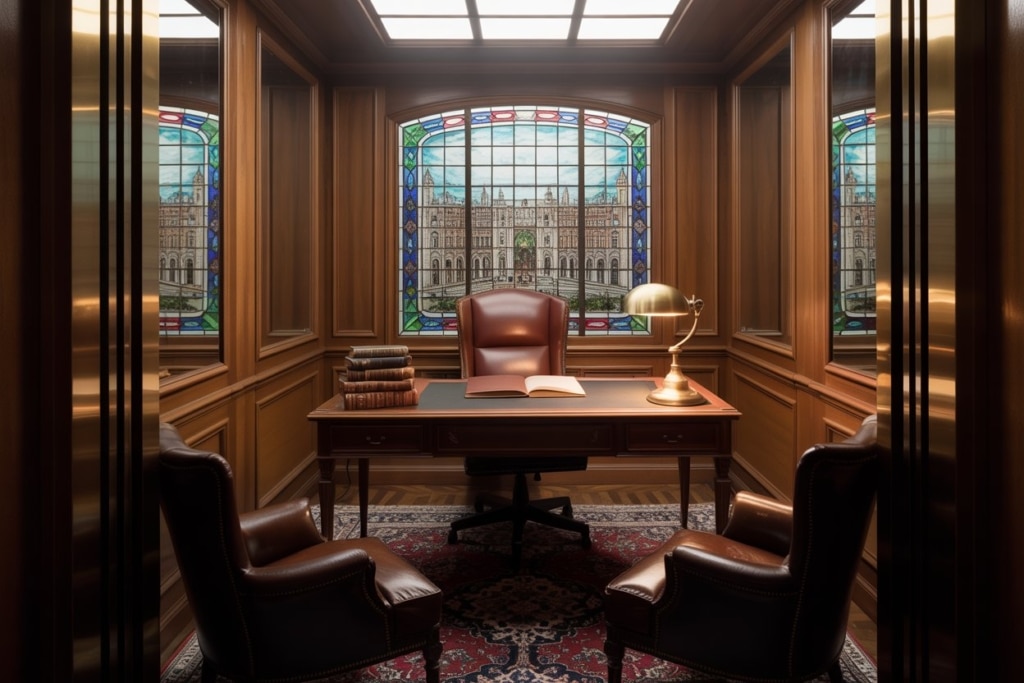
In the heart of Zlín (Czech Republic), a famous industrial city rises a skyscraping monument to ambition, creativity, and a little bit of craziness.
The Baťa Skyscraper, completed in 1939, is not Europe’s tallest nor most ostentatious building. But the only one with a CEO’s office that could commute between floors. Yes, you read that right: the boss’s office was located in an elevator.
Officially Building No. 21, the Baťa Skyscraper was built as the nerve center of the Baťa company, the small Czech shoemaking company that became a multinational giant under Tomáš Baťa and, upon his death, his half-brother Jan Antonín Baťa.
And though the building itself seems unimposing by contemporary standards, it was one of the most advanced office buildings of the day.
But it’s that elevator, Room 502, as it is officially labeled, that has earned its place in architectural legend.
The Elevator That Hides Many Surprises and More
Let’s step back for a moment. During the late 1930s, Zlín was a booming company town. The Baťa company was not merely making shoes. It was managing airlines, film studios, and factories in every corner of the globe.
With tens of thousands of employees and operations on several continents, Jan Antonín Baťa required a headquarters as up-to-date and streamlined as his business model.
And so when the time came to plan the executive office, he felt that having to walk to meetings was a waste of time.
So Baťa ordered an elevator, 5×5 meters in size, not to transport cargo, but as a full-fledged mobile command center. Fitted out by the American company Otis, this was no rickety elevator.
It was sleek, roomy, and stocked with every amenity that a CEO might need: a desk, telephones for local and international calls, air conditioning, lighting, and a working sink with hot and cold running water. When you think about it… Why not do this if you can?.
You’re most likely wondering how the hell you go about plumbing a sink in a moving elevator.
As it happens, the solution was not some sort of early 20th-century steampunk magic. There was only a water tank at the top and a wastewater tank at the bottom. Maintenance staff would fill and empty them as needed. Simple. Functional. Low-tech genius.
The office elevator is today dry and only cosmetic to a large extent, but in its day, it was meant to be functional. Baťa’s own way of not using the stairs, but still staying in contact with what was happening.
The Myth of the All-Seeing Boss
Among the long-standing myths regarding this elevator office is that Baťa employed it to spy on workers, moving between floors undetected, catching idlers in the process. It is the kind of tale that might seem well-suited to a company that was famous for its productivity and discipline.
But local guides and historians debunk that as a myth. To begin with, each floor is a vast 80 by 20 meters, and elevator doors, in a corner, wouldn’t have presented much of a view in the first place.
And there was a well-lit sign outside the shaft indicating the location of the elevator. Unless Baťa wanted to have dramatic surprise visits, the “spying boss” theory doesn’t hold water.
And above all, he did not even get a chance.
By the time the structure was finished in 1939, Europe stood at the edge of catastrophe. Hitler had already annexed the Czechoslovakian border lands, and war loomed.
Jan Antonín Baťa escaped the continent with members of his family before he ever got an opportunity to utilize his mobile command center.
A Complicated Legacy
What followed next is the kind of historical knot that only a PhD thesis would untangle. While Jan Antonín continued to manage Baťa businesses abroad, in Canada, Brazil, and India, Baťa’sEuropean operations were seized by the Nazis during World War II.
The Czechoslovak government proclaimed him a traitor after the war, and he spent the remainder of his life in exile, dying in Brazil in 1965.
But, just like elevator doors, history sometimes slides open again.
His wartime conviction was overturned by the courts of the Czech Republic in 2007. Jan Antonín Baťa was posthumously decorated with the Order of Tomáš Garrigue Masaryk, Czechia’s highest award, in 2019 for his service to society and industry.
His statue now stands across from the skyscraper he helped build, in quiet respect for a man whose vision had once been admired and reviled.
Ahead of Its Time
Even apart from the elevator office, the Baťa Skyscraper was incredible. It was centrally heated and air-conditioned on each floor, a pre-war European luxury. It had two paternoster lifts
Those continuously circulating elevators that look like a lawsuit waiting to happen, but are beloved by architecture buffs for their odd efficiency.
The entire building was built not just for form, but for function. The clean lines and absence of unnecessary design elements conveyed the company’s no-bull approach to business, and the technical meticulousness resounded:
“We’re not just making shoes, we’re constructing the future.”
And in a sense, they were. Baťa’s city planning vision, welfare of workers, and global expansion were boldly forward-thinking.
In many respects, his Zlín headquarters set the standard for the kind of tech-campus culture we’ve come to associate with Silicon Valley, a place where infrastructure, efficiency, and ambition meet.
A Working Relic
The Baťa Skyscraper is now the regional government’s principal administrative seat. But its number one tourist draw is still the elevator-office.
People can look at the space (no elevator trip, unfortunately), and technicians still drop in periodically to service the equipment, keeping it alive not just as a relic, but as a testament to the power of imagination when coupled with technical skill.
In the age where office amenities include bean bag chairs and cold brew on tap, there’s something hilariously absurd, and kind of admirable, about a guy who declared, “You know what’s better than walking to meetings? An office that moves.”
Not all old ideas must come back. But there are a few worth remembering for what they represented: boldness, oddness, and a refusal to follow the script.

No Comments