Amazon’s Jeff Bezos has never shied from sharing his unconventional views on leadership, work, and success. One of his more memorable rants? That “work-life balance” is not only wrong, it’s toxic.
Rather than two opposing forces of work and life at either extremity of the balance, Bezos argues they belong to a circle of “work-life harmony.”
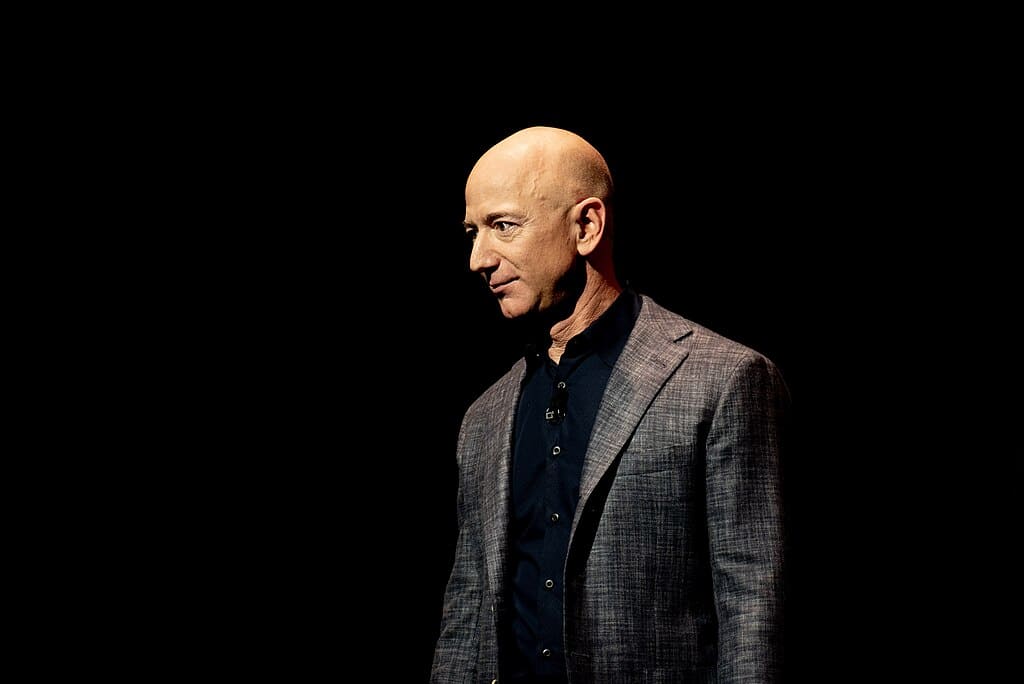
Daniel Oberhaus, CC BY 4.0, via Wikimedia CommonsBalance vs. Harmony
Back in 2018, speaking to Axel Springer CEO Mathias Döpfner at an event organized by Business Insider’s parent company, Bezos described why the term “work-life balance” does not quite sit right with him.
“I get asked about work-life balance all the time,” said Bezos. “And my view is that’s a debilitating phrase because it implies there’s a strict trade-off.”
As for Bezos, it’s that the excitement and satisfaction that you experience in one corner of your world necessarily overflows into the next.
He told Vox’s Code Conference in 2016, “I find that when I am happy at work, I come home more energized. I’m a better husband, a better dad, and when I’m happy at home, I come in a better boss, a better colleague.”
At the time, Bezos was married to MacKenzie Scott, with whom he has four children. He is currently married to former helicopter pilot and journalist Lauren Sánchez.
High Standards and Realistic Expectations
Bezos is famous for upholding the standard in business, and according to him, all of us elevate it for ourselves at the workplace. But yes, he does agree that it is never possible to be flawless.
Answering questions in 2020 at Mumbai during an interaction with Bollywood Director Zoya Akhtar and Actor Shah Rukh Khan, Bezos stated:
“If you can get your work life to where you enjoy half of it, that is amazing. Very few people ever achieve that,” he elaborated further with a quote, “The truth is, everything comes with overhead. That’s reality. Everything comes with pieces that you don’t like.”
This blend of pragmatism and ambition is similar to how he built Amazon, which is always aiming for the big milestones yet understanding the day-to-day work that they represent.
A Shift of Emphasis
Ever since he relinquished the CEO role at Amazon in July 2021, Bezos has found additional time to implement his philosophy outside of the corporate realm.
He passed the baton to Andy Jassy, the former Amazon Web Services head, and devoted his energies to other interests: the space exploration firm Blue Origin, charitable endeavors, and, of course, to the limelight of a top-tier existence with Sánchez.
Even prior to relinquishing Amazon’s top role, Bezos managed his days differently from the majority of executives.
Famous for never having an alarm, making time for family breakfast, arranging relatively few meetings, and even taking pride in doing the dishes at night, it is a life that appears to demonstrate that he lives by the words of harmony that he professes.
The Billionaires’ Club
Essentially, Bezos’s argument denies the widespread supposition that success at work necessarily needs to be at the expense of extra-professional existence, or that extra-professional duties automatically constrain professional abilities.
Instead, he argues that they can be mutually enlivening.
It’s a message that resonates with some and frustrates others. Critics point out that Bezos speaks from a position of privilege:
When you’re the world’s second-richest person, it’s easier to talk about harmony when money and resources cushion life’s hardest trade-offs. Still, his perspective pushes against a culture that glorifies burnout as a badge of honor.
For Bezos, “the circle” is not perfection. It’s forgoing the idea that work and life are in a battle of tug-of-war. If you’re heading up an international empire or just want to have space for family at the end of a day’s work, the issue is identical:
Learning to let one corner of life feed the other, rather than drain it. And if Bezos is correct, that circle is even more sustainable than is the scale.
Future Directions
Bezos’s method may be provocative, but it also raises questions that concern the future of work. As younger generations promote flexibility, telecommuting, and healthier compartmentalization, the idea of harmony over balance may come to mind more than ever.
It imagines a world in which people stop obsessing over finding the perfect assortment and start to imagine how work and life could be uplifted to complement rather than conflict.
Whether Bezos’s approach is feasible for the common worker it’s the question that could illuminate how we could redesign careers, families, and how to live well in the modern world.



No Comments