You leave a meeting certain of what was decided. You took notes. You nodded along. Then, two hours later, you get an email claiming the opposite. You read it twice. You check your notes. You start to wonder, “Am I losing my mind?”
You aren’t losing your mind. But you might be dealing with gaslighting at work.
In 2026, workplace dynamics have shifted. Remote and hybrid setups have created “psychological safety” gaps, allowing for new forms of “digital gaslighting.” It’s harder to verify reality when your only proof is a Slack message that was just deleted.
This isn’t just about a bad day at the office. Toxic workplace culture is a primary driver of burnout, and manipulation is a key ingredient.
What is Gaslighting at Work? (And What It Isn’t)

We need to be clear about what this word means. It gets thrown around too much.
It is not just someone being rude.
The Tough Boss vs. The Gaslighter
- A Tough Boss might say, “This report is bad. Fix it.” They are blunt. You know where you stand.
- A Gaslighter says, “I never asked for this report. Why are you wasting time?” (Even though they sent you the request last Tuesday).
| Type of Boss | What They Say | The Underlying Behavior |
| The Tough Boss | “This report is bad. Fix it.” | Blunt. They are direct about the quality of work. You know exactly where you stand. |
| The Gaslighter | “I never asked for this report. Why are you wasting time?” | Manipulative. They deny reality (even if they requested it last Tuesday), causing confusion. |
We now see “Ambient Gaslighting.” This includes subtle exclusion from private Slack channels where decisions happen, or “ghost edits” on shared Google Docs that change expectations without a trace. This is psychological abuse disguised as administrative error.
5 Signs You Are Being Gaslit

If you feel confused, anxious, or constantly apologetic, check for these signs.
- The “History Rewrite”
- What it looks like: They deny past events with total confidence. “I never said that.”
- What it feels like: You feel the need to record every conversation just to prove you are listening.
- The “Too Sensitive” Trap
- What it looks like: You bring up a valid concern about your workload. They reply, “You’re taking this too personally,” or “You’re being emotional.”
- What it feels like: You feel ashamed and silent, like your professional judgment is actually an emotional flaw.
- The “Ghost” Protocol
- What it looks like: They deliberately leave you off email chains or calendar invites. Later, they ask, “Why weren’t you there? We discussed this.”
- What it feels like: You feel incompetent and out of the loop.
- Credit Theft & Blame Shifting
- What it looks like: In a 1-on-1, they praise your idea. In the team meeting, they present it as their own. If the idea fails later, they recall it was “your initiative.”
- What it feels like: You feel used and defenseless.
- The “Concern” Troll
- What it looks like: “I’m worried about your performance lately.” They say this even when your metrics are high and you are hitting every KPI.
- What it feels like: You feel paranoid, waiting to get fired even though you are doing well.
Why It Happens: The Psychology of the Office Manipulator
It is vital to realize one thing: This is not your fault.
Gaslighting is rarely about your incompetence. It is usually about the gaslighter’s insecurity.
How to Break the Cycle: A 4-Step Action Plan
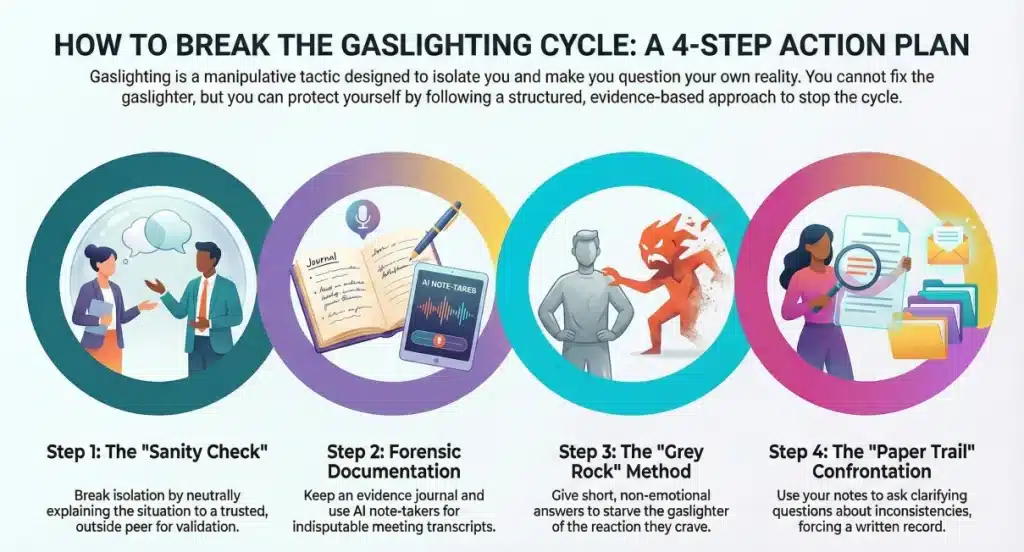
You cannot fix the gaslighter. You can only protect yourself. Here is how to stop the spinning.
Step 1: The “Sanity Check” (Validation)
Gaslighting works because it isolates you. Break the isolation.
Find a trusted peer or mentor. Do not choose a mutual friend of the boss. Ideally, choose someone outside your immediate team. Explain the situation neutrally: “I was told X, but Y happened. Does that seem odd to you?”
When another person says, “That makes no sense,” the spell begins to break.
Step 2: Forensic Documentation
Your memory is fallible. Data is not. You need a “bcc” journal.
The Action: Create a personal email address (not on company servers). Every time a weird interaction happens, write it down and email it to yourself. Include dates, times, and quotes.
The Tech Tip: Use AI note-takers like Otter.ai, Fireflies.ai, or Zoom summaries. These tools create transcripts of meetings. If a boss says, “I never said that,” you can check the transcript. It serves as an indisputable witness.
Step 3: The “Grey Rock” Method
A gaslighter wants a reaction. They want you to cry, argue, or defend yourself.
The Technique: Become as uninteresting as a grey rock. When they try to bait you or rewrite history, give short, non-emotional answers.
- “I see.”
- “Noted.”
- “I’ll check the record.”
Starve them of the emotional fuel they want.
Step 4: The “Paper Trail” Confrontation
Once you have your data, you can push back safely. Do not accuse them of lying. Use your notes to ask “clarifying questions.”
The Script:
“I’m confused. The meeting notes from Tuesday’s transcript say we agreed on Project X, but your email today says Project Y. Which one should I follow for the official record?”
This forces them to either commit to the lie in writing (evidence) or back down without losing face.
When to Walk Away: Protecting Your Mental Health
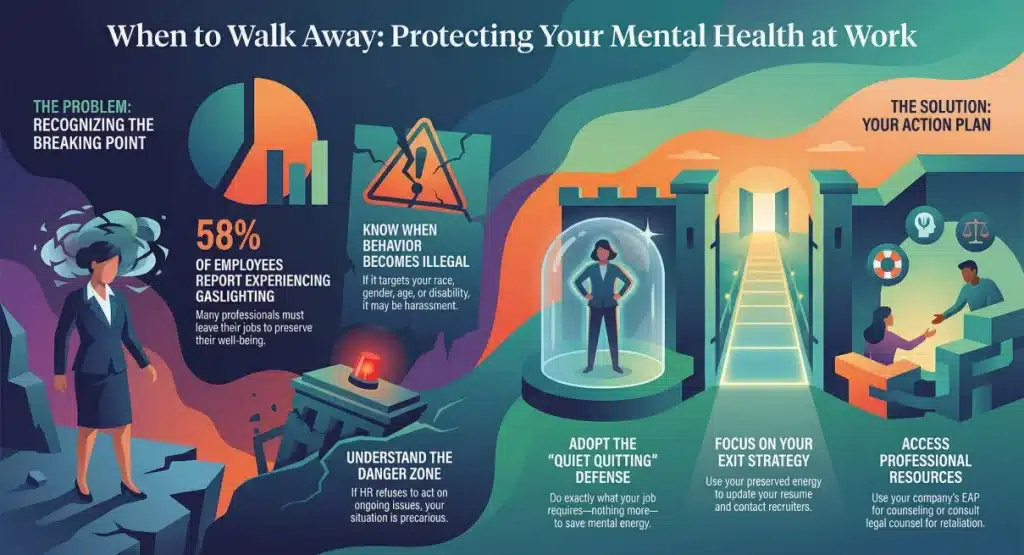
Sometimes, you cannot win.
If the behavior continues despite your documentation, or if HR refuses to act, you are in a dangerous spot. 58% of employees report experiencing gaslighting, and many have to leave to survive.
Know the Line If the behavior targets your gender, race, age, or disability, it may cross into legal harassment (EEOC triggers).
The “Quiet Quitting” Defense If you cannot quit yet, disengage. Do exactly what is required in your job description. nothing more. Use your mental energy to update your resume and contact recruiters.
Resources Check if your company offers an EAP (Employee Assistance Program). They can provide counseling. If you feel you are being forced out, consult legal counsel regarding workplace retaliation.
Conclusion
You are not crazy. You are being targeted by a tactic designed to control you.
Amy Edmondson’s concept of “Psychological Safety” proves that teams cannot function without trust. Gaslighting destroys that trust.
Your Next Step: Start your “Sanity Log” today. Open a blank document on your personal phone. Write down the last three times you felt confused at work.
Reclaiming your reality is the first step to reclaiming your career.



No Comments